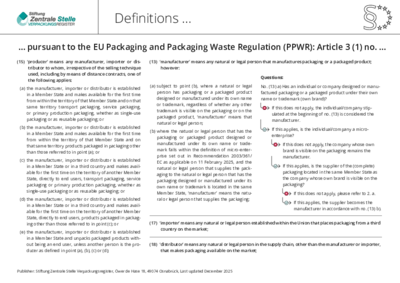
Access all PPWR definitions here
Responsibility under the PPWR – who is a manufacturer, who is a producer?
To make sure they meet their packaging law obligations under the EU Packaging and Packaging Waste Regulation (PPWR), companies need to check what their responsibilities will be.
The PPWR makes a distinction between …
… manufacturers, who are responsible for packaging conformity, and
… producers, who bear extended producer responsibility (EPR) – which means they must finance the recovery – in the EU Member State where the packaging becomes waste.
Two steps to determine responsibilities
The information below offers guidance, and a two-step process makes it easier to clearly distinguish between the responsibilities of manufacturers and producers.
Please follow these two steps to assign responsibilities:
Step 1: determine who the manufacturer is
Who is responsible for the design and characteristics of the complete packaging, i.e. its conformity?Step 2: determine who the producer is
Who is responsible for financing the recovery of packaging waste in the relevant EU Member State, i.e. for bearing extended producer responsibility (EPR)?
Under Article 3 (1) no. 13 PPWR, a manufacturer is every natural and legal person who
- manufactures a unit of packaging or a packaged product itself or
- has it designed or manufactured under its own name or trademark.
Please note: for every unit of packaging, there is exactly one manufacturer across the entire EU.
To determine who the manufacturer is, there are two main scenarios in practice:
Scenario #1: contract manufacturing
If a company has a contract packager design or manufacture a unit of packaging or a packaged product under its own name or trademark (own brand or licensed trademark), the ordering company is the manufacturer.
Please note: it does not matter whether the company owns the trademark; group companies or licensees can also be manufacturers. What matters is the connection between the name or trademark and the associated influence on the design of the packaging. Even if the contract packager is also named on the packaging, it does not matter because this neither means that the contract packager is also responsible, nor does it transfer any obligations.
Exception: if the ordering party is a micro-enterprise (pursuant to Recommendation 2003/361/EC: fewer than ten employees and an annual turnover or balance sheet total not exceeding two million euros), the following applies: if the supplier of the empty packaging or the packaged products is based in the same EU Member State, this supplier is the manufacturer. However, if a micro-enterprise orders own-brand empty packaging or own-brand packaged products from another EU Member State/outside the EU, then the micro-enterprise itself is the manufacturer.
Important for categorising: the key is who can evaluate the conformity of the packaging. That is the party who has the opportunity to exercise considerable influence on the design and characteristics of the given unit of packaging.
Scenario #2: no contract manufacturing
If there is no contract manufacturing involved, the key factor is the type of packaging and the point in time when it becomes 'complete':
1. Retail and grouped packaging: these only become packaging once they are filled; the manufacturer is the party that fills the packaging.
2. Transport, service and primary production packaging: the decisive factor here is when the packaging takes its final form, therefore becoming 'complete'.
- Rigid packaging (such as pallets, crates, boxes, takeaway coffee cups, pizza boxes) obtain their final form when they are manufactured. The manufacturer is the party that makes the empty packaging.
- Flexible packaging (such as rolled films, wrappers, straps) obtain their final form only once they are used or filled. The manufacturer is the party that puts the packaging together with all of its component parts.
A producer is every natural or legal person who, as a manufacturer, importer or distributor, makes a unit of packaging available for the first time in the EU Member State in which it becomes waste. This party bears the organisational and financial obligations of extended producer responsibility. For packaging subject to system participation in Germany, that means:
financing the recovery of packaging waste (= system participation by entering into a system participation agreement with one or more system operator(s)), and
Please note: for every EU Member State in which packaging becomes waste, the supply chain needs to be assessed to determine one producer for each unit of packaging. Depending on the supply chain, business relationship and EU Member State, companies can play different roles for the same packaged product or empty unit of packaging.
Basic determining principle: domestic precedence
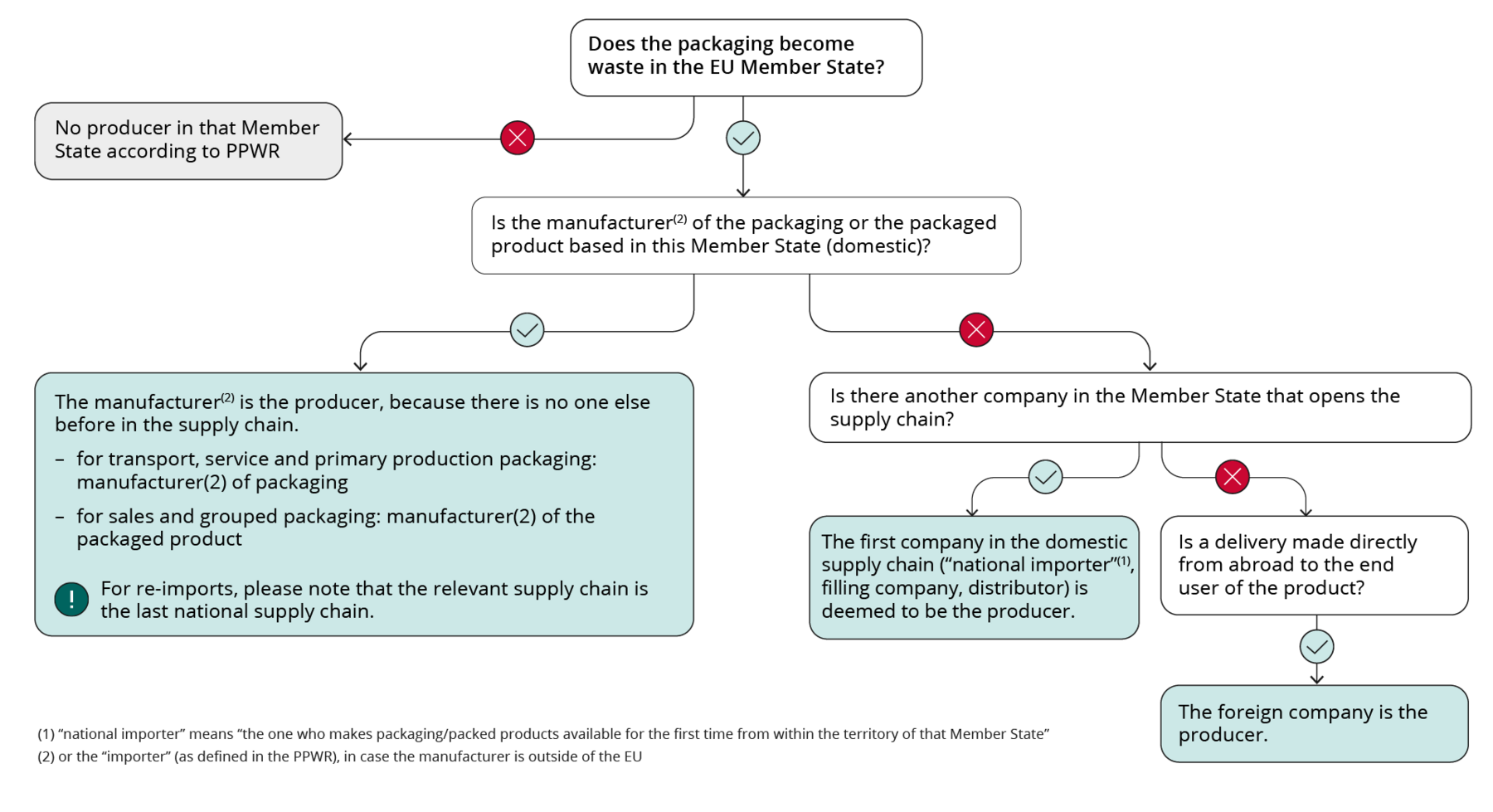
The producer is the party who initiates the supply chain in the EU Member State where the packaging eventually becomes waste (domestic precedence). This is meant to ensure reliable financing for the waste management infrastructure there.
Example: if packaging is disposed of in Germany, the first company in the German supply chain is the producer under the PPWR. It is safe to assume packaging is disposed of in Germany if the packaging was made available for the first time in Germany and there is no evidence of it becoming waste in a different Member State.
Please note: the producer is not necessarily the manufacturer of the empty packaging or the packaged products. The decisive factor is who is the first party to make it available in the domestic supply chain.
No domestic precedence: who is the producer under the PPWR?
The manufacturer, the importer or the distributor can be the producer within the meaning of the PPWR (Article 3 (1) no. 15 PPWR). If the manufacturer is based abroad, the first company in the domestic supply chain is considered the producer. For a supply chain in Germany, this could be:
the importer established in Germany that places complete, empty packaging or packaged products from a third-party country on the German market.
Please note: placing packaging on the market from another EU Member State does not constitute importing under the PPWR; a party doing so would be the distributor in this scenario.the distributor established in Germany that places complete, empty packaging or packaged products from another EU Member State on the German market.
Simplified decision tree for determining the producer
The following decision tree offers a high-level, simplified assessment tool to help you roughly determine if your company is considered a producer. Please note that this decision tree provides an incomplete picture and should be used for initial guidance only.